
Subcontractor Prequalification: The Tier 1 Procurement Checklist
What financials, safety, capability, and capacity actually need to look like before a subcontractor clears your panel — plus a free checklist to run against your own process.

What Prequalification Actually Checks
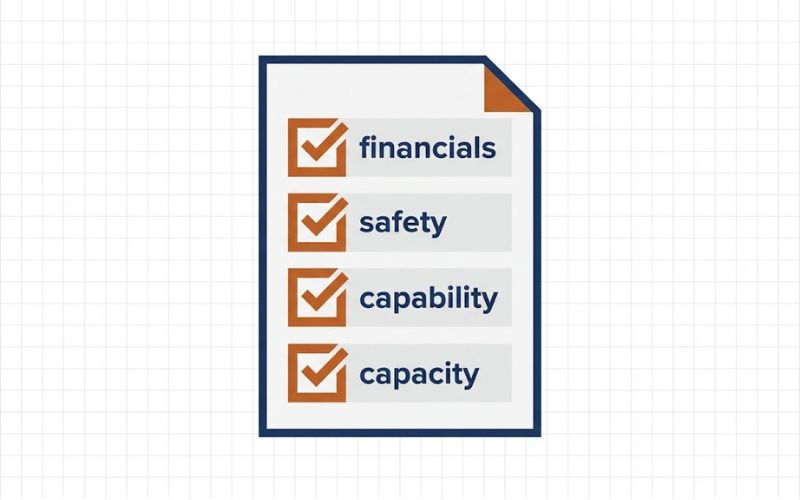
Every subcontractor prequalification process — whether it's McConnell Dowell, John Holland, Fulton Hogan, or a Queensland council — is really testing four things: financial capacity, safety systems, capability, and capacity. Financial capacity means current insurance across all required classes and evidence you can carry the cash flow of the package. Safety means a WHS management system that goes beyond a policy statement — risk registers, psychosocial hazard controls, incident procedures. Capability means a track record procurement can verify: project case studies, references, licences. Capacity means proof you can actually resource the job — plant registers, crew CVs, a surge model for peak load. Miss any one category and the prequalification stalls, regardless of how good the other three are.
Why Capable Subcontractors Still Fail It
Most rejected subcontractors aren't rejected on price or workmanship — they're rejected on documentation. A subcontractor can have thirteen years of on-time delivery and still fail prequalification because their public liability certificate lapsed eight months ago, or because "capability statement" means a one-page flyer instead of a structured document a panel can actually assess against criteria. Tier 1 procurement teams don't visit sites to make this call. They work from portals and checklists. If the paperwork isn't there in the format they need, the subcontractor is invisible — no matter how capable they are on the ground.
The Subcontractor Prequalification Checklist
We built a practical checklist that mirrors what Tier 1 panels actually assess — the same four categories, broken into the specific documents and details each one requires. It's free, it's not gated behind a sales pitch, and it's built from real prequalification runs, not a generic compliance template.
A Real Prequalification, Documented
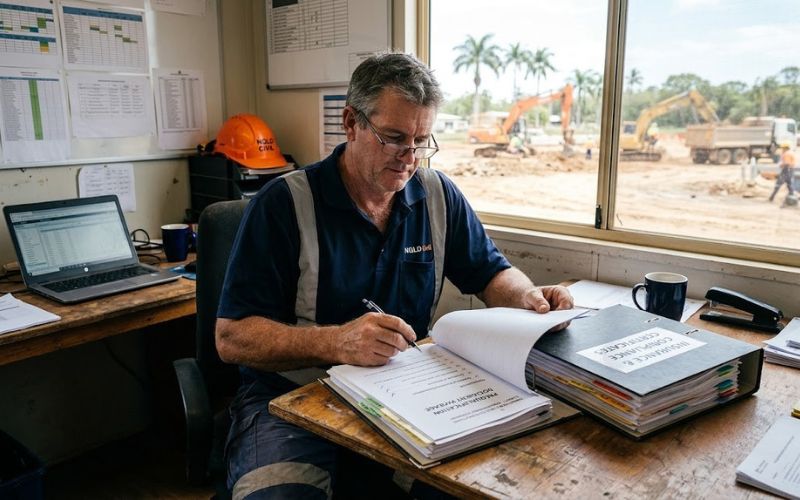
This isn't theoretical. In the Redstone Civil case study, a North Queensland civil contractor used a structured seven-tool process to build a 62-document library — averaging a 4.875 quality score across every output — and assemble a McConnell Dowell prequalification for the Haughton Pipeline Stage 2 supplier panel: seven sections answered, 25 attachments indexed, zero hard blockers at submission.
Beyond Compliance: Getting Found, Not Just Qualified
Prequalification gets a subcontractor onto the panel. It doesn't make them easy to find. The same process also rebuilds the parts of the business procurement teams actually search for — LinkedIn profile, Google Business Profile, a documented brand identity — so a subcontractor who clears prequalification is also visible when your team is looking for one.
This checklist covers the four categories a Tier 1 prequalification panel checks directly. For the broader picture of what it takes to engage with big-project supply chains — finance, WHS, capability, capacity, and insurance — see our companion resource, Big Project Supplier.
Start the Conversation
If you're building or refreshing a subcontractor panel and want to know where the real gaps are — not just for one subcontractor, but across your supplier base — that's a conversation for Raymond Ward, not a form.
Email Raymond → [email protected] | Connect on LinkedIn → linkedin.com/in/raymondeward
Frequently Asked Questions
What's the difference between a subcontractor prequalification form and a checklist?
A prequalification form is what you submit — the structured document a procurement team asks you to complete, covering financials, safety, capability, and capacity. A checklist is what you use beforehand to make sure you can answer every section without scrambling. Our checklist prepares you for the form, not a replacement for it.
What does subcontractor prequalification software actually do?
Prequalification software used by Tier 1s and councils automates document collection, expiry tracking, and compliance scoring across a large subcontractor base. It doesn't help a subcontractor prepare the documents in the first place — that's still manual work, which is the gap CDD's process closes.
Do all subcontractors need to go through prequalification, or just for bigger packages?
It varies by head contractor and package size, but the trend is toward requiring it earlier — smaller packages increasingly ask for the same core documents as larger ones, just with a lighter review. Building the document library once means you're ready regardless of which package comes up.
How long does subcontractor prequalification take to complete properly?
Done manually, gathering and formatting the required documents typically takes several weeks around normal operations. In the Redstone Civil case study, a complete document library — including a full McConnell Dowell prequalification draft — was produced in roughly seven hours using a structured process.
What's the single biggest reason capable subcontractors fail prequalification?
Expired or missing insurance, followed closely by a WHS management system that exists as a policy statement but not as an actual system — risk registers, hazard procedures, training records. Both are fixable in days once identified; the problem is usually nobody flagged the gap until prequalification was already underway.
Where can I get a subcontractor prequalification form template?
Head contractors typically issue their own form as part of the prequalification invitation, so there's no single universal template. What you can prepare in advance is the underlying document set — insurance, WHS system, capability and capacity statements — which covers what almost every version of the form asks for.